

Thinking Through a Project
A special Tips & Tools project debrief
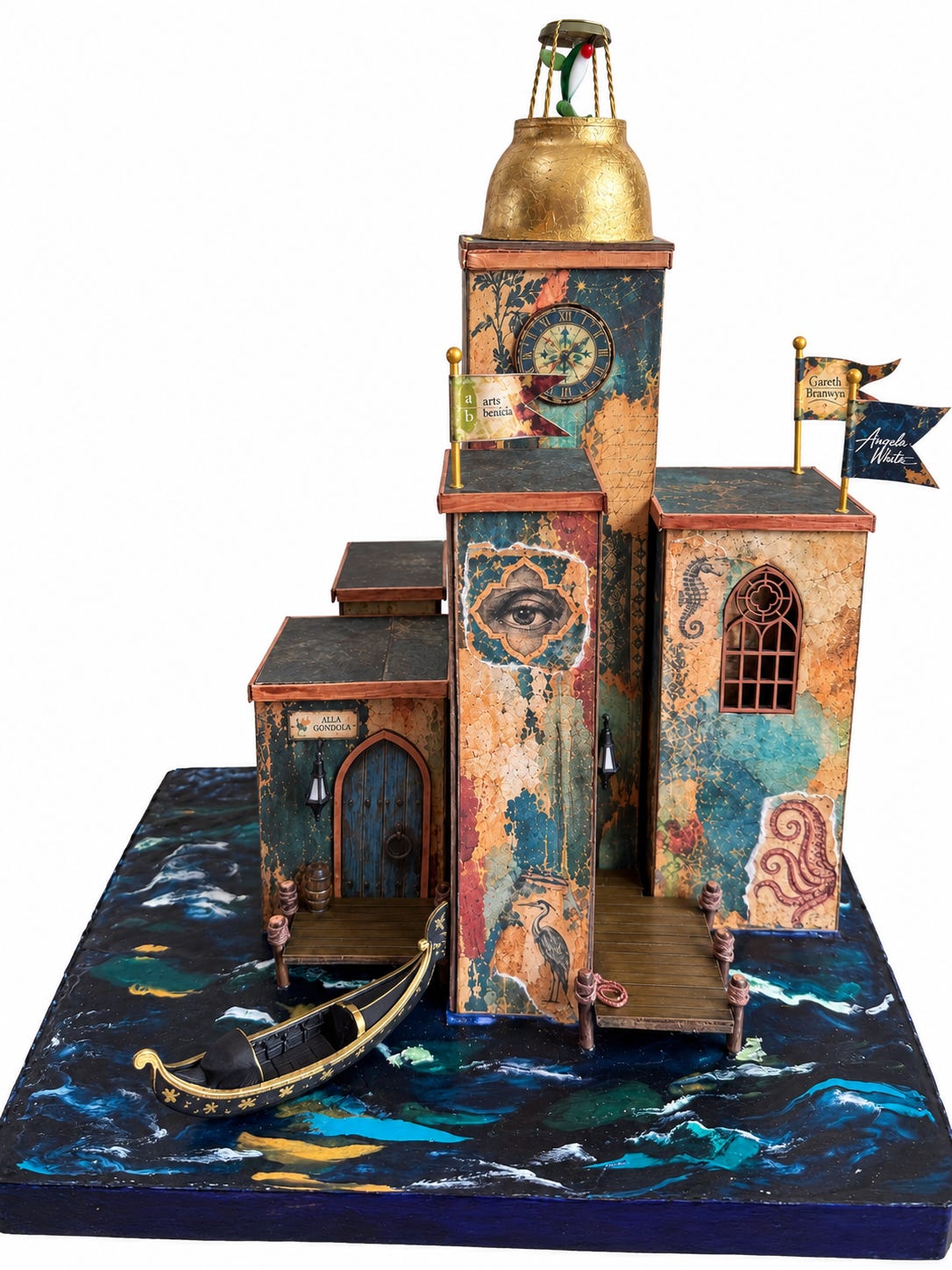
My wife Angela and I recently finished creating a table centerpiece for a Venetian-themed fundraising auction at Arts Benicia, our local arts org in Benicia, CA.
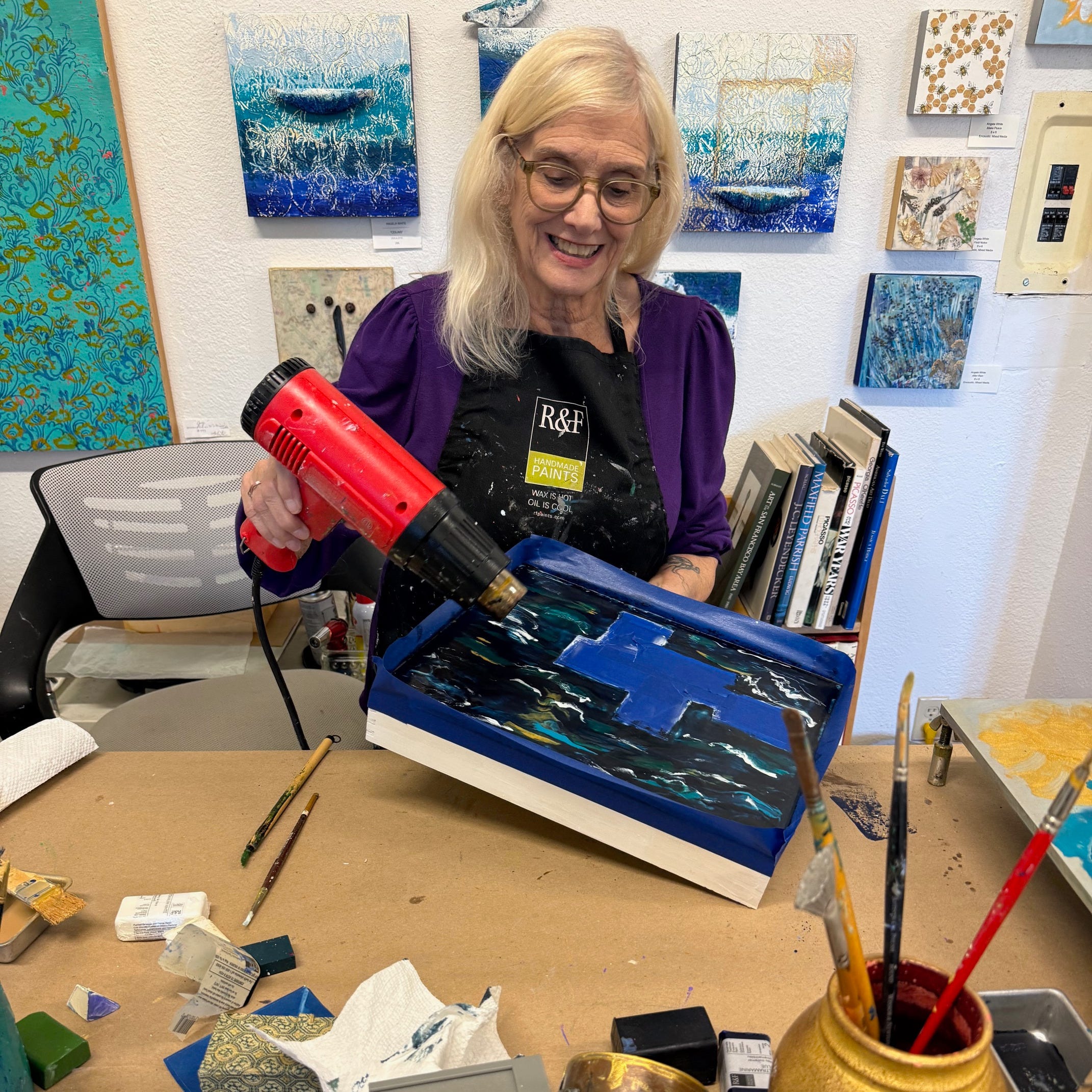
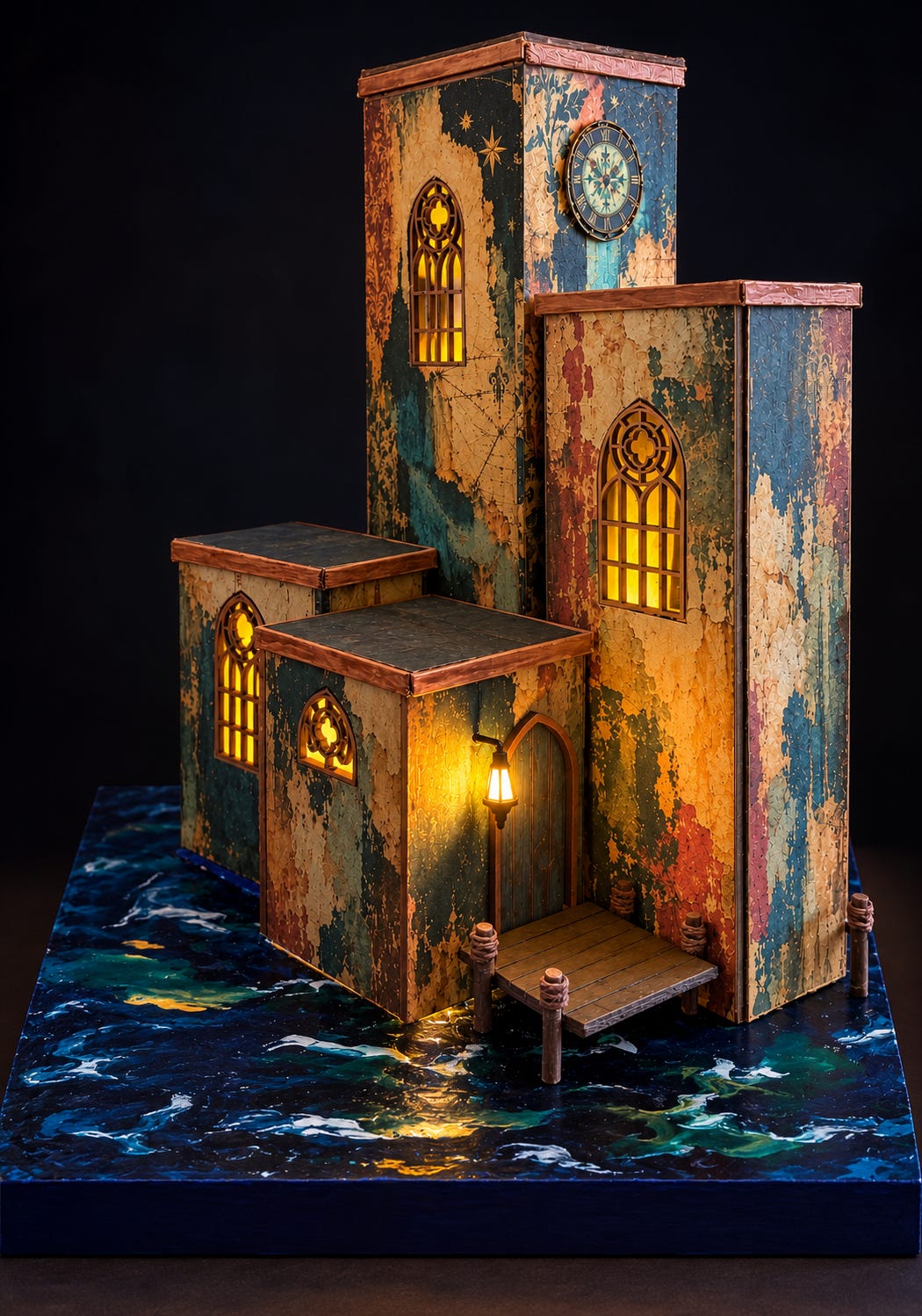
The idea we came up with was to collaborate on a dream-vision of Venice. On a raised wooden platform (an inverted craft store serving tray), Angela would create a dark and mysterious sea in encaustic wax and I would build a “City of Dreams” rising from the murky waters. We didn’t want it to be a literal model of Venetian architecture, but rather a sort of hard-to-resolve mixture of typical Venetian imagery overlapping surreal dream imagery.
As we planned and got excited about the project, it grew in scope into an elaborate tabletop assemblage with five buildings, docks, a gondola, and working LED lights. The buildings were made from 80-point chipboard, covered in collaged papers, with little architectural details added here and there. It was one of the most involved physical projects I’ve undertaken in years.
And I loved every minute of it. Almost.
The design and build were surprisingly complicated and took a lot of forethought to get right. It became this giant puzzle that I was increasingly determined to solve. Over the course of that process (I estimate 50 hours, all-totaled), I had a number of thoughts and aha’s I thought I’d share with you, dear reader.
Here are my post-project thoughts and takeaways.
Making a Model of the Model Before the Model
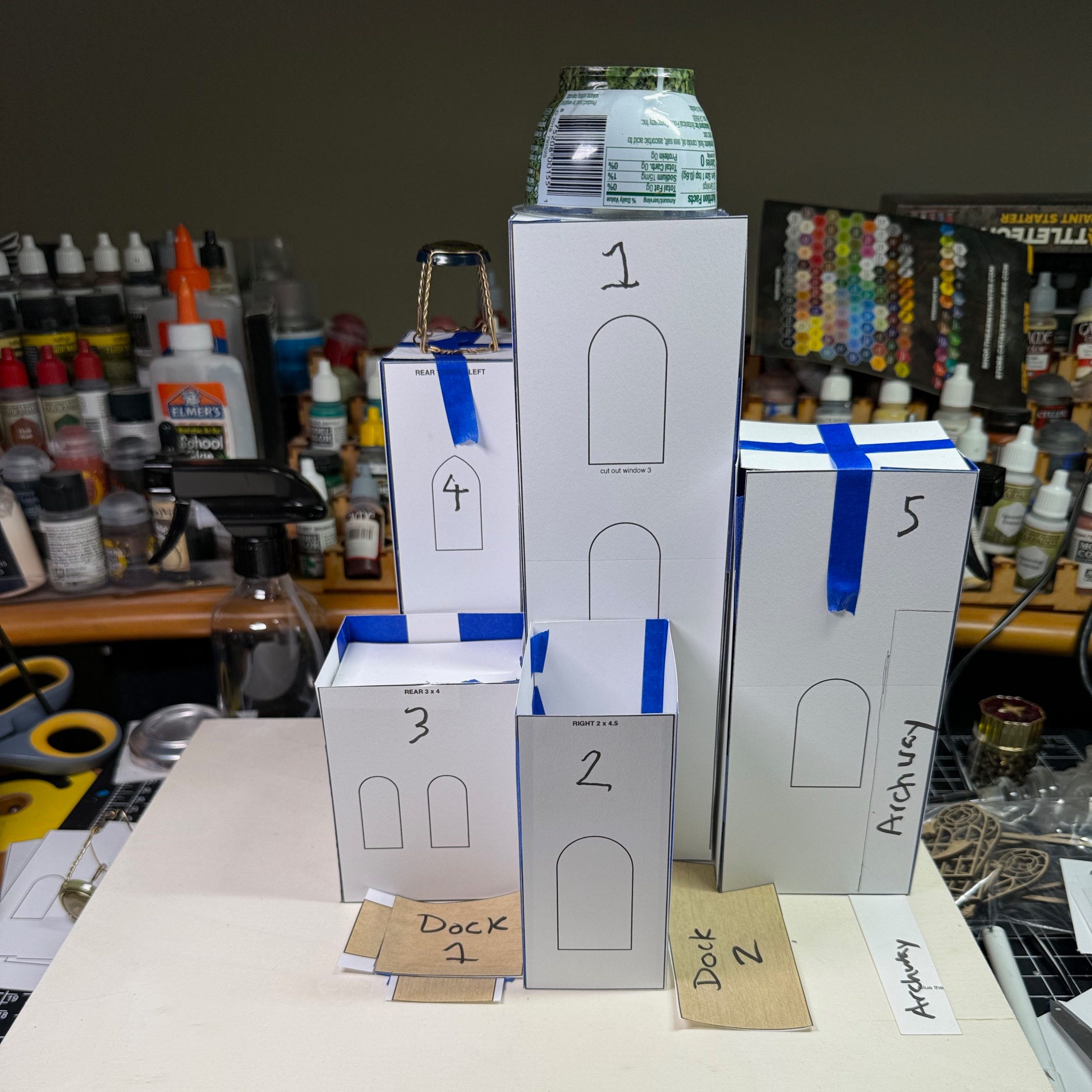
Before cutting any chipboard, I built a complete paper model of our little city. Nothing fancy, just simple bond paper versions of the buildings, but that mock-up was invaluable throughout the project. It helped me work out the overall composition and relative sizing, determine where windows and doors should go, and to create the masking layout of the city’s footprint that Angela could use while applying the encaustic to the wooden base. It also gave me something physical to stare at, rearrange, and think with. It took a few hours to design, cut, and assemble the crude paper version, but I’m sure it saved me lots of frustration later.
The Importance of Sequencing
On the very first building, I made a classic rookie mistake. I assembled the chipboard tower before cutting out its windows. This meant I had to cut the windows after the fact, through extremely tough 80-point board, while trying not to crush or distort the assembled structure. Lesson learned. For the rest of the build, I became obsessive about sequencing. What has to happen before something else can happen? What will become difficult or impossible once these two pieces are glued together? Do I need to cut, paint, drill, or measure something now, while I still have easy access to it? There’s something deeply satisfying about getting the order of operations right. It’s like solving a little puzzle before you even pick up a tool.
Slow is Smooth, Smooth is Fast
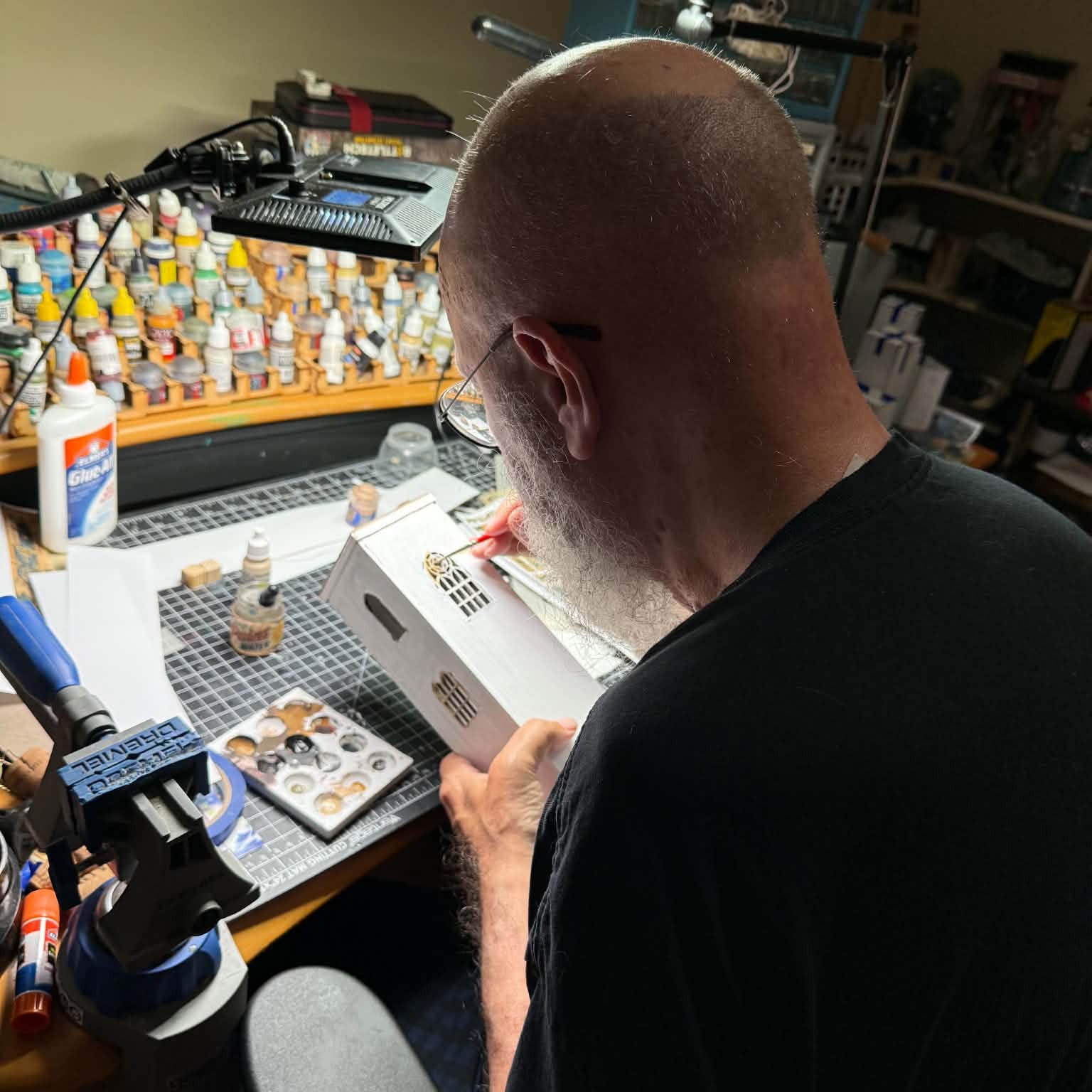
This old military adage is something we also use at my day job, and it was certainly in evidence here. I had five buildings to construct, each with its own peculiarities, but all using the same techniques. The first one was very slow and awkward. By the second, I had developed a better understanding and workflow. By the third, I was really getting the hang of it all. And by the fifth, I was moving along at a satisfying clip, making fewer mistakes, and getting much better results. The trick wasn’t trying to work faster. It was working more deliberately, figuring out the process, and allowing speed to emerge from growing competence.
What Could Possibly Go Wrong?
Years ago, I learned an invaluable shop safety tip from maker and friend Andy Birkey: Always be thinking about what could possibly go wrong. This became something of a mantra during the City of Dreams build. I estimate that I made somewhere around 2,500 cuts with a hobby knife and utility knife. That’s a lot of opportunities to draw blood. With every cut, I had to remain aware of where my fingers were, how I was holding the ruler, where the blade would go if it slipped, and whether I was applying more force than I should. I also had to be aware of my own state. Was I too tired? Distracted? Rushing to finish one last cut before bed?
With that many cuts, often after a full day of work, the chances of an accident seemed all-too-high. And yet, I made it through the entire project without a single cut or even a close call. I attribute that to staying mindful of the potential consequences of every operation. Not fearful… attentive.
Sharp Blades and 1-2-3 Blocks
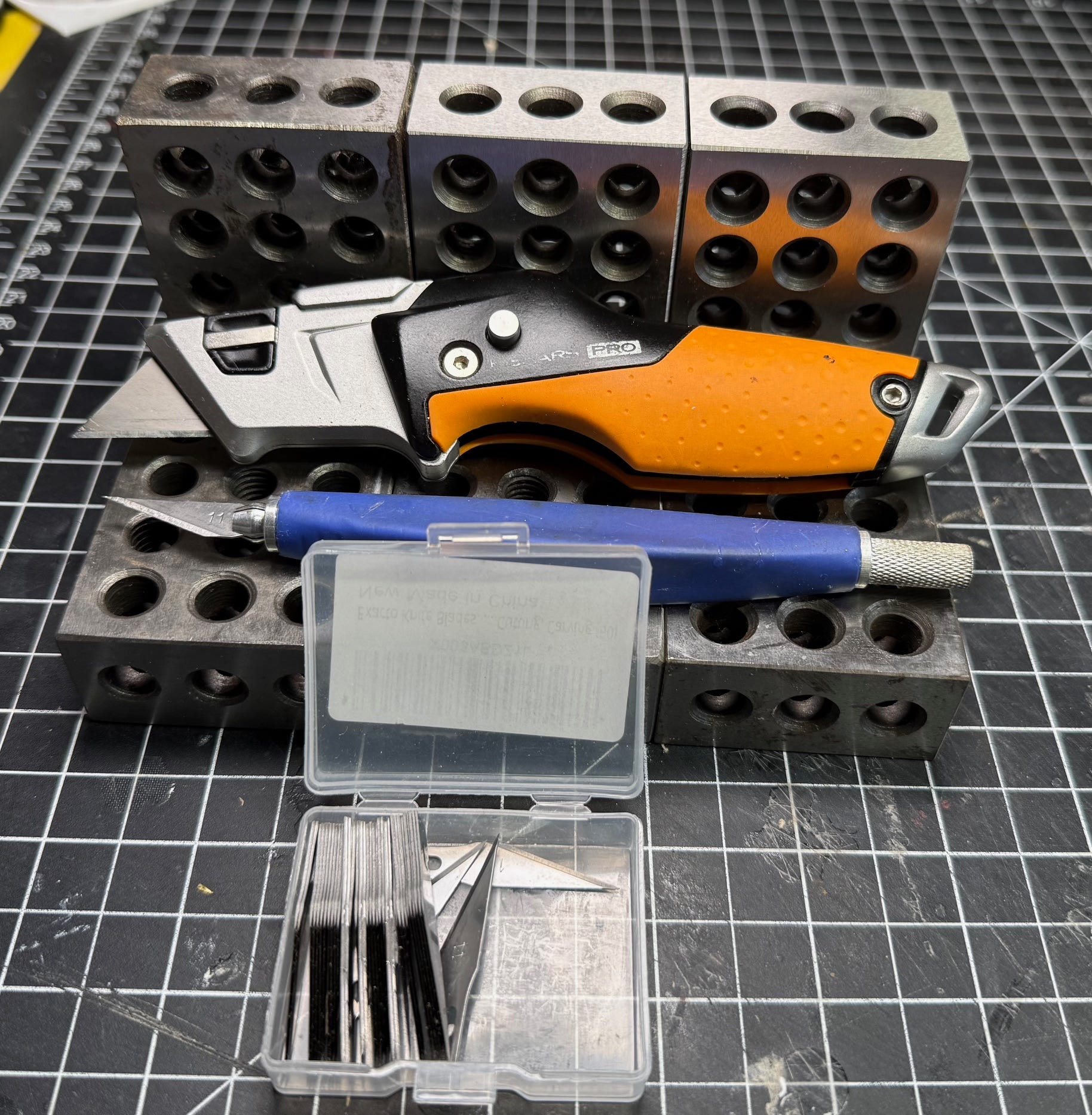
I’ve written before about the virtues of buying inexpensive replacement hobby knife blades rather than pricey name-brand X-Acto blades. The reasoning is simple: If blades are cheap enough, you won’t hesitate in replacing them. I went through at least 15 blades during this project. Sharp blades require less force, produce cleaner cuts, and are generally safer because you’re less likely to lose control while forcing them through material..
If I had to nominate an MVP tool for this project, it would be my collection of 1-2-3 blocks. These are precision-machined steel blocks measuring exactly 1 by 2 by 3 inches, usually drilled with a pattern of holes. I used them constantly. As measuring references, as squares for checking angles, as weights, as supports for cutting, and as little fixtures for holding chipboard pieces at perfect right angles while the glue set. I even discovered that the holes were ideal for holding bamboo skewers upright while tiny decorative elements I’d glued to their ends dried.
The Kenny Rogers Rule
Years ago when I used to build hobby robots (and was writing a book about it) I came up with The Kenny Rogers rule: “Know when to hold ‘em, know when to fold ‘em, and know when to walk away.” There were several points during this project when I found myself getting frustrated, trying to force something to work, or just feeling too tired to think straight. And more than once, the best tool I reached for was the light switch.
I’d go have dinner, watch some TV with Angela, go to bed, have a cocktail. Often, when I returned, the solution was suddenly obvious. Or at least I had enough distance from the problem to approach it differently.
There’s a peculiar kind of stubbornness that one can fall into, where walking away feels like giving up, but knowing when to stop is itself a skill. Sometimes the most productive thing you can do for a project is to leave it alone.
Thinking About Thinking About Making
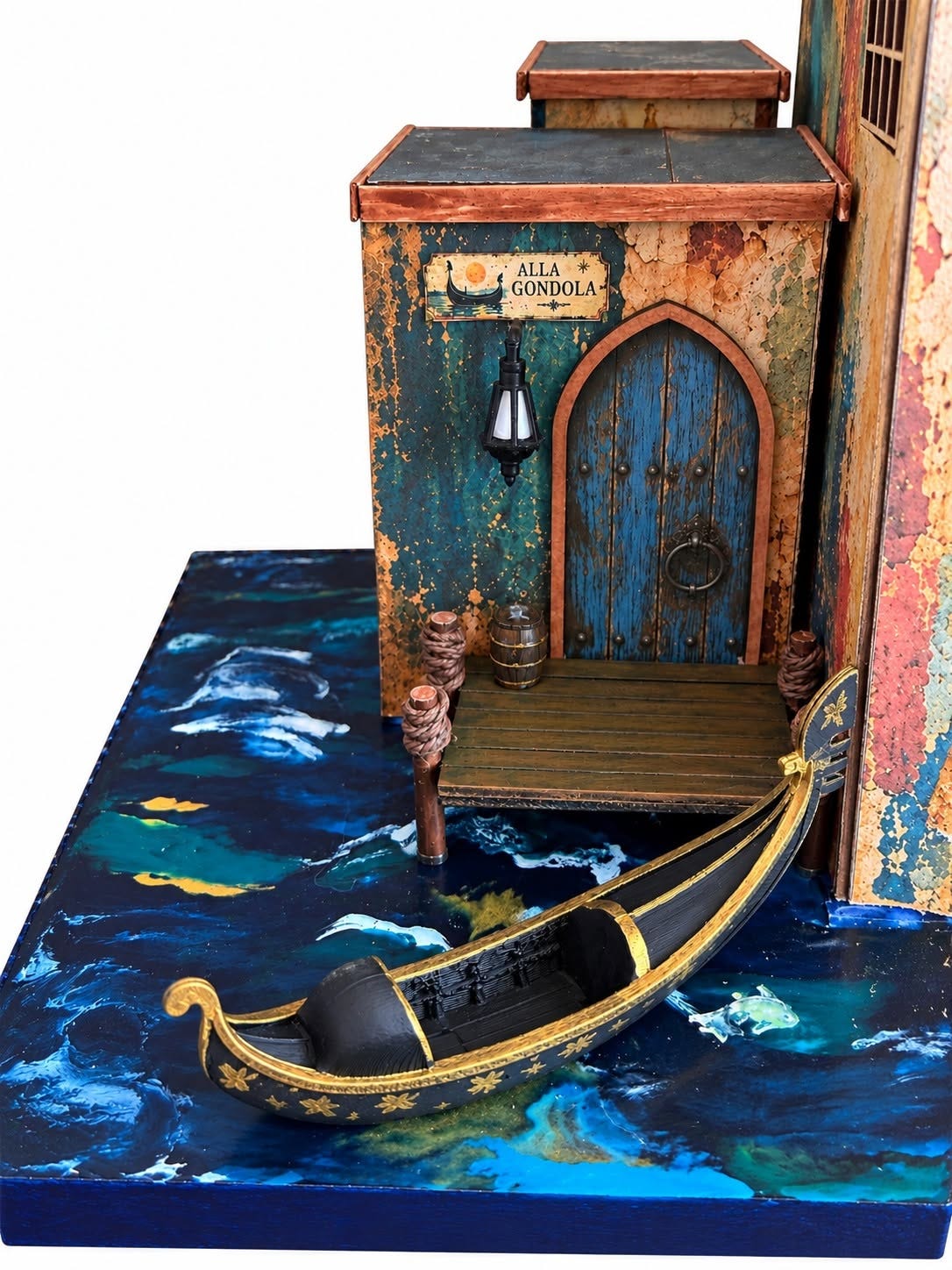
What I loved most about this project was the mental and imaginal space the project occupied while I worked on it. It consumed most of my idle thoughts (in the shower, going to sleep, having lunch, etc.).
For weeks, I was kind of living inside that tiny world of chipboard, paper, glue, wax, and miniature lights. Every decision had consequences for other decisions. Every problem presented another little challenge. I was constantly moving between the big picture and the tiniest detail, between strategy and tactics, planning, and improvising.
I suspect this is a big part of why so many of us like making stuff. Yes, we want the finished object. We want the satisfaction of holding something tangible in our hands and saying, “I made this!”
But there’s also the pleasure of having a project take up residence in your imagination. Of having something to puzzle over while you’re taking out the trash, drifting off to sleep, or standing in the shower. Of being engaged in an ongoing conversation with your materials, your tools, and your own developing understanding of how things work.
For me, that’s where a lot of the magic happens.
The finished Venetian city was the destination. But the weeks I spent mentally inhabiting it were at least half the project’s reward.
Thanks to All My Subscribers!
I now have well over 10,000 subscribers to this humble little newsletter. And 50 paid subscribers. A million thanks to all of you. Doing this newsletters is a true joy for me and I especially like feeling like I’m connected to a community of fellow makers. Thanks to everyone who’s sent me an email, made a comment, shared a tip or tool. Let’s keep the ball rolling for another 200 issues!
If you want to financially support this work, please consider a paid subscription. It helps keep me in PB Swiss. I appreciate you.
A very special thanks to Hero of the Realm subscribers: Moses Hawk, Jim Coraci, Donobster, Peter Sugarman, and Will Phillips for your generous support.
"I’d go have dinner, watch some TV with Angela, go to bed, have a cocktail. Often, when I returned, the solution was suddenly obvious. Or at least I had enough distance from the problem to approach it differently."
This solution is otherwise known as the "MacGyver Technique". Lee even wrote a book about it:
https://macgyver.com/the-macgyver-secret/
This is a great essay! Thank you for the reminder to savor big projects, and to take your time. I will rely on it for my upcoming baking day.