

Know Your Egress!

In 1978, I was living in the attic of an old farmhouse with a bunch of hippies. One night, I woke up to a bedroom filled with thick, choking black smoke. I leapt out of bed, and in the dark, headed toward what should’ve been the hatch and ladder down to the first floor. I got there and found no hatch. Solid plywood floor. I panicked and literally started scratching at it, as if I could claw my way out. Smoke alarms were blaring all over the house. I began frantically crawling along the walls until I finally found the hatch.
The smoke had been caused by some malfunction in the ancient oil furnace. When it cleared and I went back up to my room, I saw that in my smoke-choked confusion, I had crawled to the exact opposite corner from where the hatch was. I also had a door that led out onto the flat roof of the kitchen. Why hadn’t I used that instead of heading toward the smoke billowing up from the furnace?
This experience taught me a lesson I’ve never forgotten. In a smoke and fire emergency, your brain can play seriously dangerous tricks on you. Ever since that night, I’ve tried to put my egress route into muscle memory. And as the (what my wife and I jokingly call) House Safety Officer, I check it each night before bed to make sure nothing is blocking it: no shoes, no bags or boxes by the door, nothing hanging from the door handle, nothing that could cause even the slightest confusion in an emergency situation in the dark.
Book Review: Maintenance: Of Everything

It’s not common to say that a book changed the course of your life, but the 1970s Whole Earth Catalogs, helmed by Stewart Brand, absolutely changed mine. To this day, pretty much everything I’m involved with (DIY tech and media, small press publishing, computers and digital networking, self-reliant living, even tabletop wargaming) first came to me through the pages of Whole Earth. Brand, now 87, still has my attention. In his latest book, Maintenance: Of Everything (allegedly the first in a multi-volume series) he takes a rambling, often compelling trip through the world of machines and the value of maintaining them.
Part One focuses on boats, cars, bikes, and weapons of war (guns and tanks). As one person commented on social media, this could be called Maintenance: For Boys as there is no mention of sewing, food systems, domestic maintenance, etc. But I assume that will be coming in future volumes. There were sections in this book that really lit me up and others that left me flat. The opening chapter on The Sunday Times’ Golden Globe 1968 single-handed, round-the-world yacht race was a knuckle-biter and really drove home the critical importance of planning, organization, and maintenance. And the section on the history of “hackable” cars like Model Ts, VW Bugs, and Russian Ladas, was inspiring. The through-line here is the utility and nobility of a cultivated “maintenance mindset.”
While I’m glad I read this book and learned some fascinating and useful things from it, it never felt like it delivered on its promise. It didn’t even feel that focused on maintenance. It spent just as much time on invention and innovations in precision manufacturing. It felt more like a WEC-like scrapbook of cool and compelling ideas than a well-crafted argument for maintenance. I was hoping to come away from it with a Zen and the Art of Motorcycle Maintenance level of appreciation for the art of maintaining the mechanical stuff in my life. Maybe Brand is playing the long game here over the entire series of these slim volumes (200 pgs.). I’m definitely interested to see where Part Two takes things.
Five Great Humble Tools
I love when James of Stumpy Nubs does these tool recommendation videos. Here he goes over five tools made by makers or small tool companies: The Merlin Square from Izzy Swan, the DrillBlock from Milescraft, the Scribing Caliper, track saw bag, and the Harvey Tools bandsaw fence. Obviously, Stumpy Nubs is a woodworking channel, so he’s coming at these tools from that trade, but honestly, all of them are relevant to any DIYer who has a home shop and does measuring, marking, cutting, and sawing.
Table Saw Basics from Leah Bolden
I have always appreciated the calm, gentle, and wise way that carpenter and DIY educator, Leah Bolden, shares her knowledge. I’m sure her videos speak to lots of beginners who might otherwise be intimidated by… in this case… tools like table saws.
Leah teaches like someone who’s watched a lot of beginners face the same fears and make the same mistakes. Her advice is simple, almost to the point of feeling obvious, but that’s the point. Unplug the saw before touching the blade. Keep your hands clear and never in line with the cut. Don’t try to get fancy with setups that can pinch the wood and kick it back at you.
She also talks about the small decisions that add up. Blade height isn’t just about cut quality, it’s about risk. Push sticks give you distance, which gives you safety. And those “extra” features people sometimes remove, like riving knives and guards, are doing real work in the prevention of kickback.
Nothing revolutionary here, but that’s what makes it useful. It’s a reminder that most shop accidents don’t come from ignorance so much as attention drift and cutting corners.
Building a Maker School, One Faux-Cast Iron Bracket at a Time

Jimmy Diresta and I go way back. He did early videos for Make: magazine, before he became the YouTube superstar he is today. I remember the point in which he permanently moved to his farm in upstate New York. He arrived with plans of turning it into a maker school. Lots of people have similar such dreams. But Jimmy has the tenacity, drive, and obviously the money, to make such dreams come to life. It’s been really gratifying to see him methodically building that school, board by board. He’s turning that farm into quite the maker mecca. In this video, he works on the pottery studio for his second barn. In installing all of the shelving needed for the studio, he needed lots of sturdy brackets. He had an antique cast iron bracket he liked, so he decided to translate that into a digital file using Procreate on his iPad, image-trace it in Illustrator, to create a CNC file for his Onefinity CNC machine. He used scraps of cheap and Baltic birch plywood. Once cut and sanded, he spray painted them black and the final result looks convincingly like cast iron (from a distance, anyway). He ends up producing 65 of these brackets. Again with the tenacity.
No-Cut Bent Plywood Stool
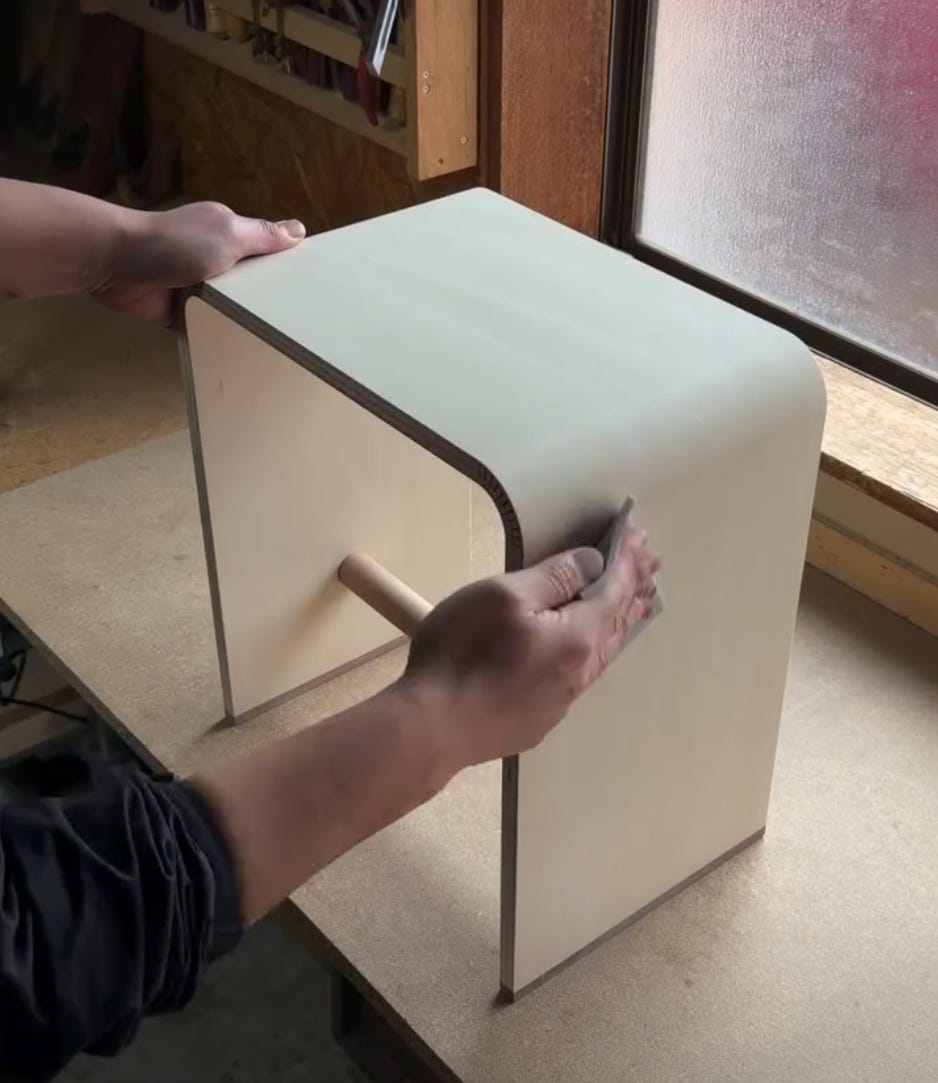
I love the simplicity and elegance of this simple bent wood stool by Takurou Seino. Bonus link: Check out this unique way of no-fastener shelf construction.
Consider a Paid Subscription
Gar’s Tips & Tools is free. But if you really like what I’m throwing down and want to support it, please consider a paid subscription. Same great taste, more cheddar to help keep me in mini flashlights. Plus, I’ll occasionally pick paid subscribers at random and send them little treats, tools, or tip-related treasures.
Your support keeps this whole Rube Goldberg-style contraption lovingly cobbled together and running…smoothly (enough). Thank you!
Special thanks to Hero of the Realm members: Moses Hawk, Jim Coraci, Donobster, Peter Sugarman, and Will Phillips for your generous support.
Gar,
Some folks call me crazy, some think I am too suspicious, but I always look for emergency exits.
It’s not manic; it just seems good
sense to me.
In an emergency, you must be safe before helping anyone else.
Great post as always, Cheers,
Kkb